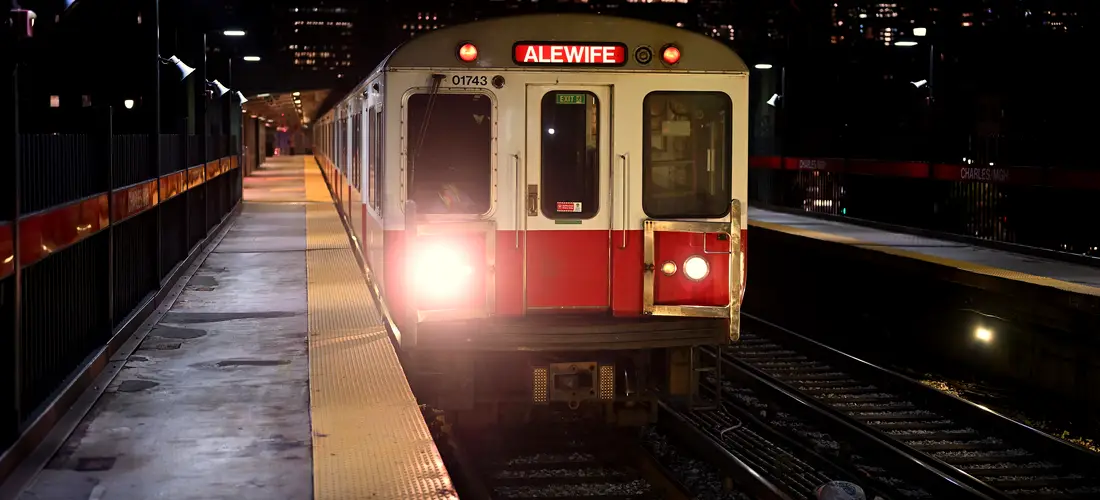

In March 2016 Boston.com photographed the last late-night Red Line train waiting to leave Park Street, read the caption, and that was it: no ceremony, no reprieve. One rider, who remembered the Night Owl buses dying the same way a decade earlier, summed up both: it just disappeared. Boston has killed late-night transit twice. The third try is running now, and it is smaller on purpose.
Night Owl: the first try
The T's first late-night attempt was a bus program. The Night Owl launched in 2001 and ran buses along train routes on weekends, into the small hours. WBUR reports that it was axed in 2005 over budget issues and low ridership. Those four years set the template: launch with fanfare, watch the numbers, cut when the money gets tight.
The 2014 pilot
The second attempt was bigger. Late-night subway service began on March 28, 2014. The Dorchester Reporter said that for the first time people could ride the subway into the early hours of weekend nights. It was paid for in part with private money. The sponsors, per the release the T sent out, included the Globe, the Red Sox, Dunkin' and the Restaurant Association, kicking in over $1.5 million toward a $16 million estimate.
Early numbers looked fine. In the first weeks the T counted 2,430 riders entering at the five Dorchester Red Line stations, with Ashmont the busiest. The restaurant association's president had a more specific benefit in mind: the service helped employees get home after their shifts, not customers. That detail matters for what came next.
What went wrong
The sponsor money did not last. The T's general manager said later that the hoped-for private subsidy never really materialized, leaving the agency to carry the cost. By late 2015 the service had been scaled back and ran on all subway lines and 10 key bus routes on Friday and Saturday nights.
Then the numbers. The T said it cost $14.4 million in a year, for 1.4 million trips, about 0.4 percent of bus and subway trips. That worked out to a subsidy of $13.38 per late-night trip, against $2.07 across the system.
One board member raised a different problem. Late service leaves less time for overnight maintenance, and the system was far behind on maintenance work already. We cannot say how much that tipped the vote, but it explains why the board that signed off on cuts was not sentimental.
The vote
On the last Monday of February 2016, the T's board voted 4-0 to end the service. Transportation Secretary Stephanie Pollack told reporters that ridership did not justify the investment. By the end, WGBH reported, only about 13,000 trips were made nightly over the additional 90 minutes of service.
Not everyone accepted that. Advocacy groups filed a federal complaint in July 2016, saying the T never properly gauged the effect on low-income and minority riders. The T said the Federal Transit Administration found its analysis properly documented. The groups said they were not asking for the old service back. One attorney said they wanted something else in its place.
What runs now
The fix did not come as a headline. WHDH reported in August 2025 that service would run later on Fridays and Saturdays starting August 24. Streetsblog's summary is the useful one. The subway got about an extra hour on Friday and Saturday nights, with the exact last departures varying line by line. Separately, five frequent bus routes run later every day of the week.
Look at what changed since the first subway pilot. The new version adds about an hour on weekend nights plus a handful of busy bus routes, with no sponsor money to vanish. It is a modest bet, and a modest bet is more likely to survive a budget meeting. We would rather have this than another grand pilot that dies in two years.
Gov. Maura Healey pointed to it when she backed later bar hours this summer, saying the state had expanded the T's hours. Whether it is enough to match a 3 a.m. last call is a different question, and one the Globe's operators raised themselves: most subway and key bus service shuts down before the late bars do.
Who it hurt
The people who felt the cut most were not the ones in the bars. Boston.com wrote that for service industry workers on odd hours it was a blow, and that some college students and barhoppers felt it too. One concession worker at the Garden told the paper she was not sure how she would get home from late events, since a taxi or an Uber would likely be prohibitive.
The comparison people use to argue for more service is global. WGBH pointed out that an early transit shutdown is normal in London, Rome and the Bay Area, so Boston is not an outlier in how early the trains stop. That is the sort of fact that cuts both ways, which is why this fight never stays settled.
What to do with this
Do not trust a memory of what the T used to do, and do not trust this page for tonight's times. Our Last Train page shows the actual last departures from your station for the night you are going out, and getting home after last call covers buses and the fallbacks when the trains have stopped.
If your night ends later than your line, plan the ride before the first round: a late bus, a walk to a station where lines meet, or a ride you have already agreed to split. Do not leave it to the end of the night. If you are hungry on the way, Eat Late lists what is open, and why Boston closes at 2 AM explains why you are doing all this at the same hour as everyone else. And why Boston has no 24-hour diners is the same story, told with coffee.
What the ride home costs when the T is not running is worked out in what a night out costs in Boston.
- boston.com/news/local-news/2016/03/19/it-was-the-last-ride-for-late-night-mbta-s
- wbur.org/news/2016/03/18/late-night-mbta-ends-alternatives
- dotnews.com/2014/proposals-seen-likely-reshape-nightlife-boston
- wbur.org/news/2015/11/18/mbta-late-night-service-cuts-budget-gap
- wbur.org/news/2016/07/27/federal-complaint-mbta-late-night
- whdh.com/news/mbta-announces-trains-will-run-later-on-fridays-and-saturdays
- mass.streetsblog.org/2025/09/05/tonight-mbta-promotes-new-late-night-service-with-free-rid
- nbcboston.com/news/politics/massachusetts-happy-hour-healey/3962612
- bostonglobe.com/2026/07/09/business/boston-bars-3-am-closing-time-permanent